 AcrosstarBaZi consultations · 1:1
A hexagram as a state snapshot
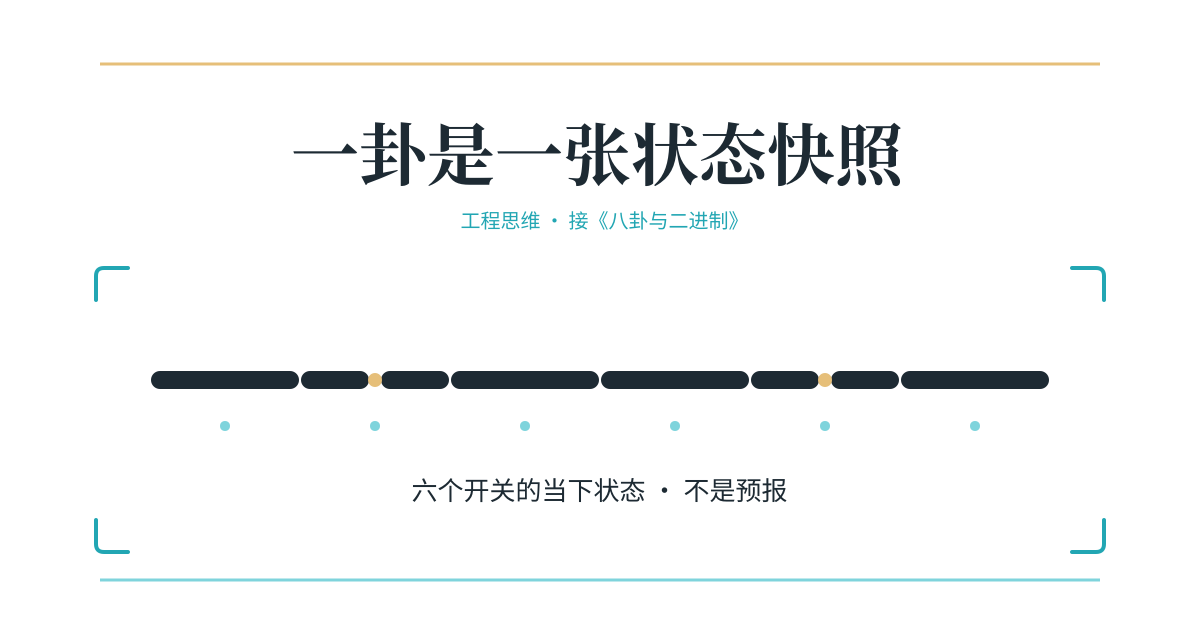
Maybe you know this feeling: you're a little curious about your own recent tendencies — you'd like to know "what state am I in right now." But you don't want fortune-telling. The moment someone promises success or disaster, you tune out. This piece is for that situation.
An earlier post covered the trigrams and binary. This one goes one step further: read a hexagram as a snapshot of your state.
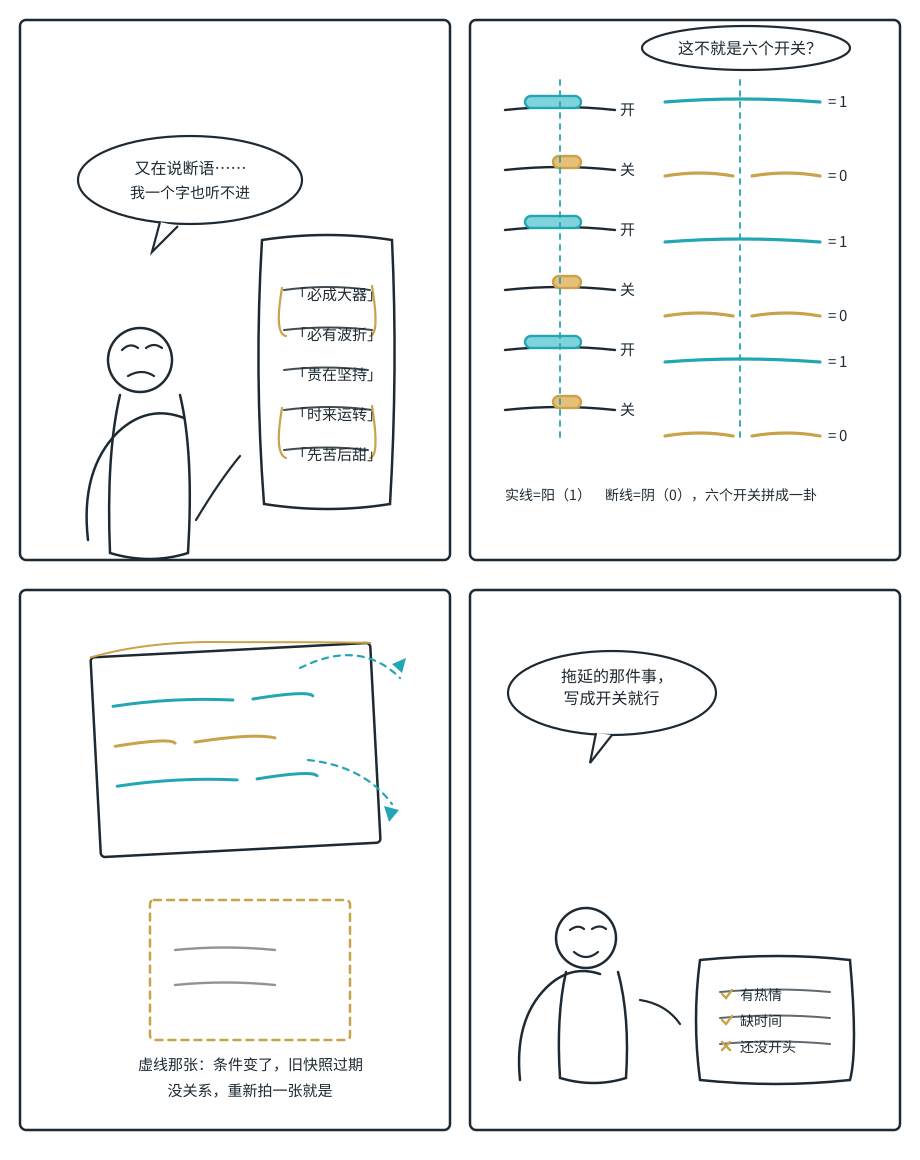
Start with the structure. A hexagram has six lines, stacked bottom to top. Each line has two forms: solid for yang, broken for yin. Borrowing a term from engineering, write yang as 1 and yin as 0, and a hexagram becomes a six-digit binary string — sixty-four combinations in all. This is only a structural analogy, a way to see the figure as a set of switches. No other system needs to be brought in.
Six switches, each on or off, combine into what the system looks like right now. The hexagram's name is the name of this set of states. It is not a verdict written in advance. It is a label, so you can remember it, talk about it, and look it up.
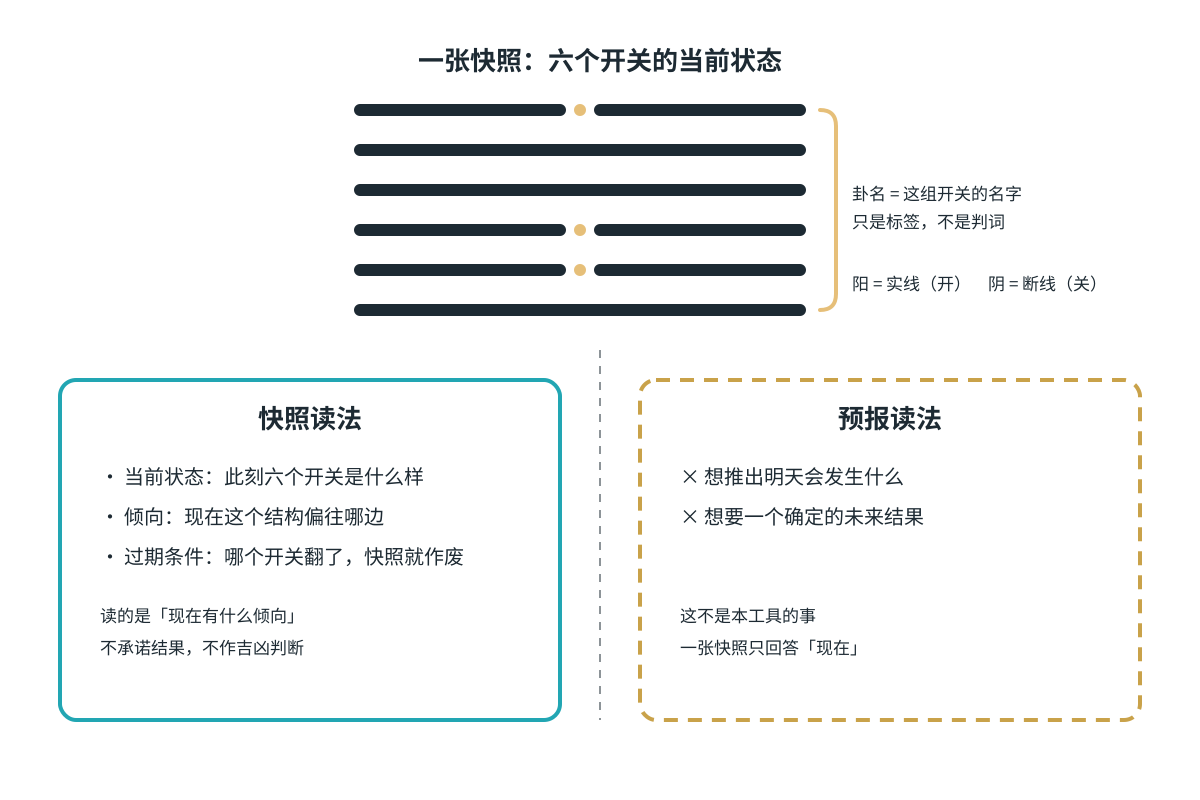
Reading a snapshot means reading where the state leans right now. If several switches lean the same way, the system's momentum follows. If some push against each other, the situation feels stuck. These are descriptions of the present structure. They help you see what conditions you are in — not to ask "what happens tomorrow."
This is the key point: a snapshot is not a forecast. A forecast tries to infer a concrete result at some future moment. A snapshot only records the structure and tendency of this moment. It guarantees nothing about what comes next, and it calls no outcome good or bad.
A snapshot has one more natural property: it expires. Conditions change, a few switches flip, and the old snapshot stops holding. That's normal. A photo captures one instant; the people and the environment keep moving; the photo isn't wrong, it just no longer shows the present. Taking a new snapshot is simply looking at the structure again. Nothing mysterious about it.
So when reading a hexagram, three questions are enough: what is the state right now, where does it lean, and under what conditions would this snapshot stop holding. The first two help you understand the present. The third reminds you to stay flexible.
No fortune or misfortune is judged here, and no birth information is needed. A snapshot describes structure only; it passes no verdict on anyone. Compare it with your own situation and keep whatever is useful.
One small thing you can do today: pick one task you've been putting off, and write down its current state as "which switches are on, which are off." Take one look at what you wrote. That's enough. No score, no reading.
Acrosstar offers cultural readings and structured analysis based on Chinese BaZi (Four Pillars), for self-reflection and decision support. It describes tendencies, does not predict events, promises no specific outcome, and is not medical, psychological, legal or financial advice. For major decisions, consult a licensed professional in that field. For adults 18+ only.
Want your own situation drawn as a map?
Start with a free topic check: describe your question and we reply whether it suits a reading and which tier fits.