Heavenly Stems and Earthly Branches: A 3,000-Year-Old Time Encoding Scheme
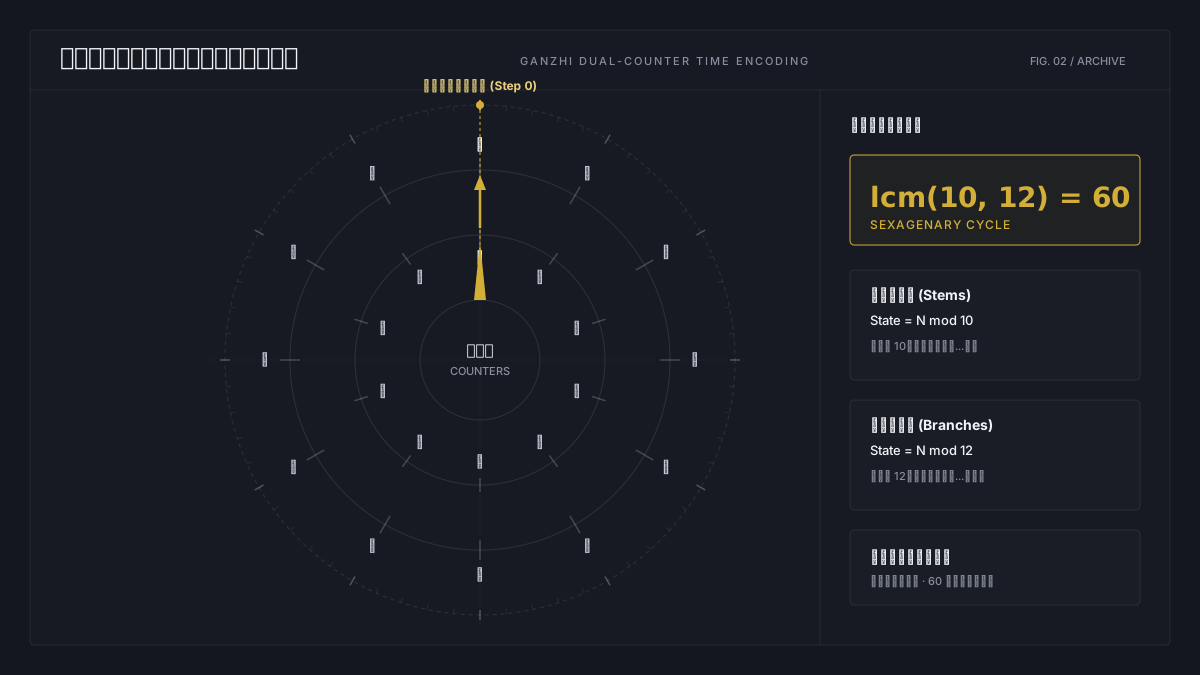
Recording time sounds straightforward, but it presents a genuine engineering challenge. In an era without clocks, answering what day it was required a universally recognized set of counting rules. The Heavenly Stems and Earthly Branches served as the solution designed by ancient scholars, remaining in continuous operation for thousands of years.
Structural Design
The system comprises ten Stems (Jia, Yi, Bing, Ding, Wu, Ji, Geng, Xin, Ren, Gui) and twelve Branches (Zi, Chou, Yin, Mao, Chen, Si, Wu, Wei, Shen, You, Xu, Hai). Modeling these as two discrete counters captures the architecture well: one counter resets every ten steps, and the other resets every twelve steps, cycling independently while operating in tandem. Ancient texts depicted a mechanical analogy where the sun wheel and moon wheel act like intermeshing gears that meet at a designated alignment point called Chen. This structural design mirrors the logic of syncing two software timers configured with different execution periods.
Cyclic Behavior
The core constant is sixty. The least common multiple (lcm) of ten and twelve is sixty, meaning the two counters realign after sixty steps, producing sixty unique, non-repeating pairs—the Sexagenary Cycle (Sixty Jiazi). Rather than sixty arbitrary designations, this represents one complete period of a periodic function, returning to origin after sixty steps before initiating the next iteration.
The system's continuity is particularly noteworthy. A standard calendar resets to month one after completing month twelve. Branch month tracking operates differently: after the Zi month, it does not loop back to Zi immediately, but advances sequentially through Chou, Yin, and onward along the global sequence. Year boundaries are equally deliberate: folk tradition marks the zodiac change at Lunar New Year, whereas the Stem-Branch system shifts years at the Spring Commences (Lichun) solar term, maintaining distinct boundary definitions without conflict. This demonstrates that the Stem-Branch system is not a small circular dial, but an uninterrupted stream of time counting—sampling segments for years, months, and days from the same underlying running sequence. At a higher abstraction layer, the framework attempts to unify years, months, days, and hours under base-60 representation, sharing a single sequential log across the entire calendar.
Calendars as Algorithms
Deconstructed to core mechanics, a calendar functions as a date computing algorithm: establish an epoch origin, accumulate by a fixed step size, apply carry operations at overflow boundaries, and execute recalibration when drift occurs. The Stem-Branch framework follows this pattern: anchoring at year start, incrementing daily, and cycling every sixty steps. That a design formulated three millennia ago remains active on modern calendars demonstrates exceptional operational stability.
Encoding Requires Calibration
Any encoding mechanism inherently faces precision limits and boundary drift. Ancient astronomers measured shadow lengths with gnomons to correct accumulated solar year errors. In contemporary usage, calculating Stem-Branch time requires True Solar Time, reflecting the same signal processing principle: clock time represents a standardized uniform index, whereas solar position constitutes the raw physical signal. With every fifteen degrees of longitude introducing a one-hour shift in solar time, synchronizing the reference clock back to the physical signal source remains an indispensable decoding step. Regardless of runtime duration, periodic clock alignment prevents signal-clock phase misalignment.
Core Takeaways
The Heavenly Stems and Earthly Branches illustrate a fundamental engineering principle: time can be encoded as structured data. Every encoding framework involves boundary conditions, error margins, and calibration routines. By systematically addressing these three aspects, ancient designers created an encoding system that maintained integrity over thousands of years. Reviewed today, it resembles a classic yet dependable timing engine with clean gear ratios and well-defined periods.
This article is a culture-structure explainer from a programmer's perspective only; it does not constitute career, relationship, medical, or investment advice.