The Bagua and Binary: A Shared Coordinate System
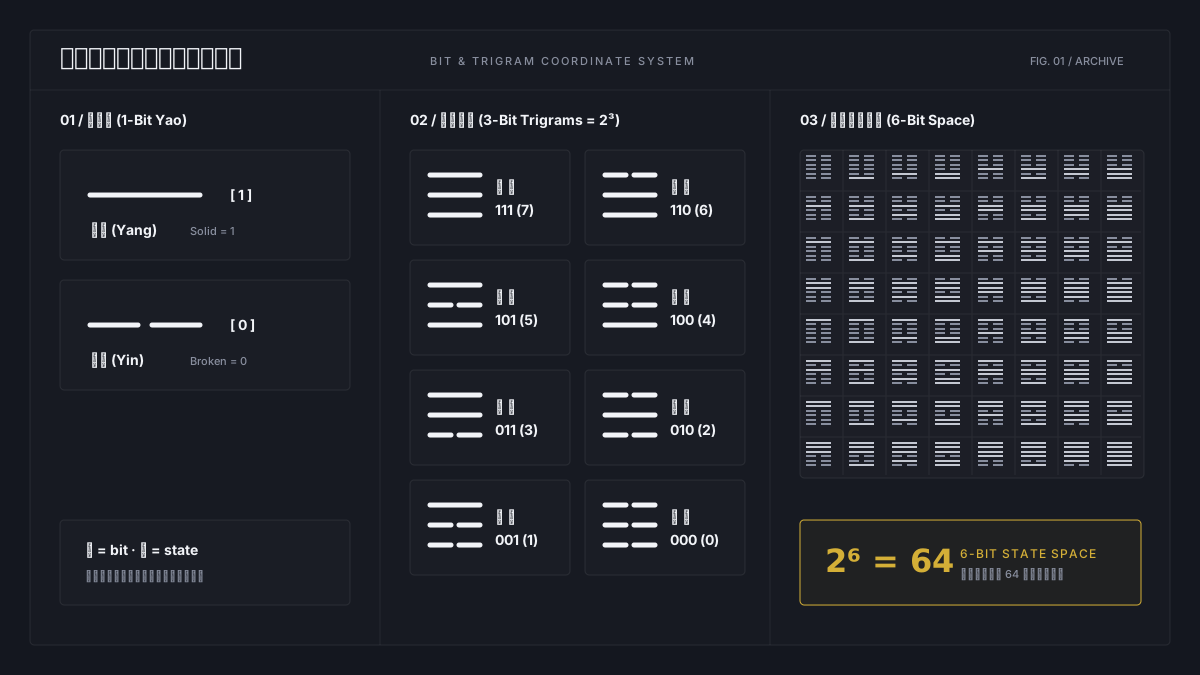
Anyone who has written code knows that at the lowest level of computers, there are only 0s and 1s. Interestingly, people three thousand years ago were working with a system of nearly identical structure, and they developed it with remarkable rigor.
A Yao Is a Bit
A bit is the smallest unit of information, taking a value of either 0 or 1. Representing a Yang line as 1 and a Yin line as 0 makes this ancient symbolic system resemble machine code. This is not a forced analogy, but a structural isomorphism: both use minimal binary distinctions to construct descriptions of the world. One bit offers two states, two bits offer four, and three bits offer eight, corresponding exactly to the Eight Trigrams (Bagua). Stacking further to six bits yields two to the sixth power, or sixty-four, corresponding precisely to the Sixty-Four Hexagrams. In terms of information capacity, the ancient symbolic system shares the same state space as a 6-bit register—sixty-four distinct states, fully representable within a single lookup table.
Each of the sixty-four hexagrams consists of six lines, totaling three hundred eighty-four lines (Yao), which ancients mapped to the days of a year. This encoding scheme does more than list states; it assigns each state to a temporal position, functioning much like state indexing. Taking it further, layering hexagrams pairwise creates sixty-four times sixty-four, or four thousand ninety-six combinations, which ancients arranged in a deterministic order. In ancient application, sequence served as temporal order—once the state table was arranged, time was embedded into the encoding.
Coordinates Behind the Eight Trigrams
The arrangement of the Eight Trigrams is not arbitrary; each trigram maps to a spatial direction. The origin of this coordinate system was selected deliberately, using the position of the North Star as the zenith baseline, from which four cardinal directions project. Ancients constructed the Early Heaven and Later Heaven diagrams, essentially defining two reference frames for the same state space—one observing the sky, the other observing the earth. For software engineers, this concept is familiar: re-rendering the same dataset under a transformed coordinate reference frame.
The Luoshu square takes this further by arranging numbers one through nine into a three-by-three matrix—nine on top, one at the bottom, three on the left, seven on the right, and five in the center—where every row and column sums to fifteen. Here, symbols gain grid-like row and column structure, moving far beyond casual drawing.
Ordering Enables Search
Once a state table exists, the next logical step is retrieval. Ancients sorted hexagrams based on the count of Yin and Yang lines, starting from an extreme point and incrementing the count of Yin energy sequentially, establishing a formal enumeration rule. This aligns with the logic of looping through a state space: define a starting point, specify a step direction, and iterate exhaustively.
Encoding the World
Looking back, the essence of the Bagua system lies in abstracting physical phenomena into symbolic representations, then ordering and combining them by spatial direction and sequence to create a searchable lookup table. Today, this process is called encoding. Without microchips, ancients conducted formal engineering in data encoding, complete with coordinates, state representation, and indexing. Understood this way, this ancient symbolic system operates much closer to a structured data model than one might expect. Contextualized in an era before paper and ink, this underlying encoding mindset represents the true value of the system.
This article is a culture-structure explainer from a programmer's perspective only; it does not constitute career, relationship, medical, or investment advice.